The coronavirus relief bill released Monday includes $250 million in investment aid for the Palestinians and for encouraging Israeli-Palestinian dialogue in a provision titled the “Nita M. Lowey Middle East Partnership for Peace Act of 2020.”
The provision, named for retiring Rep. Nita Lowey (D-NY), is buried deep within the nearly 6,000-page legislative text.
Citing economic stagnation in the Palestinian Territories, and the potential for economic development to encourage peace, the Lowey Act would spend $50 million per year for the next five years. A version of the act passed the House in July.
The act would create the “People-to-People Partnership for Peace Fund,” run by the U.S. Agency for International Development (USAID) to “provide funding for projects to help build the foundation for peaceful co-existence between Israelis and Palestinians and for a sustainable two-state solution.”
It would also support projects that foster dialogue between Arab and Jewish citizens of Israel. The fund would have an advisory board of 13 members, plus two members “who are representatives of foreign governments or international organizations for renewable periods of 3 years.”
The act would also create the “Joint Investment for Peace Initiative,” which would provide investment funding for “projects that contribute to the development of the Palestinian private sector economy in the West Bank and Gaza.”
The act prohibits the funding from being used to aid any foreign government, including the Palestinian Authority and the Palestine Liberation Organization (PLO). It also prohibits funds from being given to any group deemed to be involved in, or encouraging, terrorist activity.
Congress limited funding to the Palestinian Authority in 2018 under the Taylor Force Act, which prevents U.S. taxpayer dollars from going to the Palestinian government while it continues to pay stipends to terrorists and their families.
President Donald Trump has also cut other forms of U.S. funding to the Palestinians. His Middle East peace plan, introduced earlier this year, provides for a two-state solution, on condition that the Palestinian state be demilitarized and reject terrorism.
Joel B. Pollak is Senior Editor-at-Large at Breitbart News and the host of Breitbart News Sunday on Sirius XM Patriot on Sunday evenings from 7 p.m. to 10 p.m. ET (4 p.m. to 7 p.m. PT). His newest e-book is Neither Free nor Fair: The 2020 U.S. Presidential Election. His recent book, RED NOVEMBER, tells the story of the 2020 Democratic presidential primary from a conservative perspective. He is a winner of the 2018 Robert Novak Journalism Alumni Fellowship. Follow him on Twitter at @joelpollak.
via Breitbart News
Enjoy this article? Read the full version at the authors website: https://www.breitbart.com


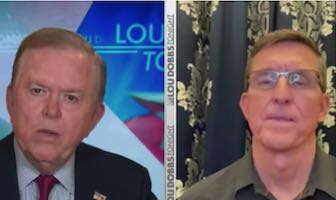 General Flynn: What I would say is SolarWinds is an entry point into the rest of our entire US critical infrastructure. So everything that touches the United States government, if you enter through this SolarWinds attack that we perceive you basically have keys to the vault… You’re able to rummage around and do damn near anything. So it’s a very, very serious attack… We’ve known about it for about six months as I understand it. So when we talk about our election security, Lou, I think this is all part of it because there’s a relationship between these SolarWinds attacks which has basically penetrated our entire infrastructure as well as our election securities… We know we have evidence of foreign influence in the election and this too. You know we’re talking about countries like China, countries like Iran, countries like North Korea, like Russia. These are adversaries that want to basically dominate with their ideology this country…