Watch: How China Is Enforcing The Corona Quarantine By Drone
China has found new ways to respond to coronavirus that has shut down at least two-thirds of its economy, taken offline some of the world’s largest manufacturing hubs, and quarantined more than 50 million people.
The country is using drones, specifically DJI drones with front-mounted speakers, to fly around towns and yell at anyone who isn’t wearing a mask.
It’s like something from a dystopian film, but essential to critical quarantine enforcement.
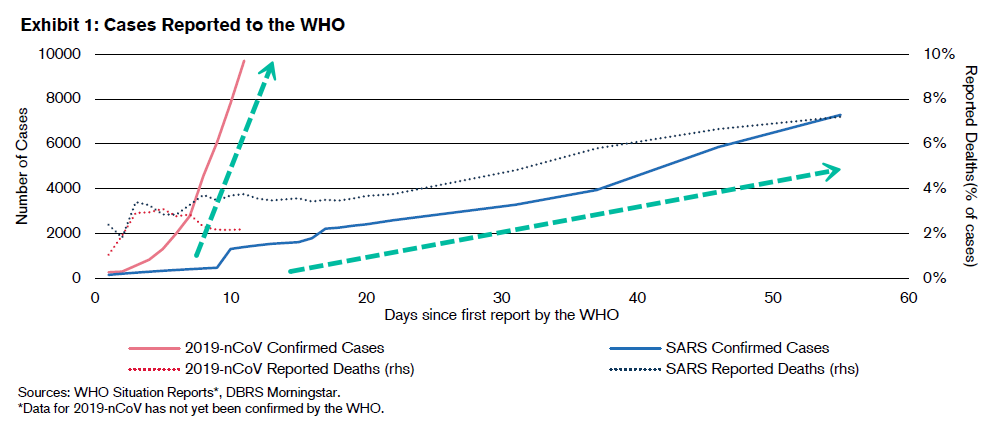
With confirmed cases around 10,000 in China, about 213 deaths, and tens of thousands of people with suspected coronavirus, the communist government is deploying technology to beat the "devil virus."
"Staying at home is contributing to society," a government official tells people in this video posted by Global Times, which slows a DJI drone with a front-mounted speaker flying around a rural countryside and urban areas yelling at anyone not wearing a virus mask.
Walking around without a protective face mask? Well, you can’t avoid these sharp-tongued drones! Many village and cities in China are using drones equipped with speakers to patrol during the #coronavirus outbreak. pic.twitter.com/ILbLmlkL9R
Gizchina.com reports that some Chinese towns are deploying agriculture drones with 5-gallon sprayers to spray disinfectant, with hopes that the virus could be eliminated.
UK researchers now suggest 75,800 people are infected in Wuhan, as compared to SARS, the infection rate of coronavirus is exceptionally high. China is using advanced technology to fight a virus that could wind up collapsing its economy.
China’s Crackdown On Pajama-Wearers Sparks Surveillance-State Backlash
Avid Zero Hedge readers are probably aware that the Communist Party leadership has managed to construct a surveillance apparatus in the country’s largest cities that tracks its citizens with panoptic precision. Spit your gum out on the sidewalk in Beijing, and your ‘social credit score’ – a government ‘rating’ that quantifies your obedience to laws and social customs – might take a hit.
While this system is also used for more nefarious purposes – minority Muslims in the far Western state of Xinjiang have been placed under constant surveillance as President Xi and the Party work to undermine adherence to Islam and mold the ethnic Uyghurs into obedient Communists – Beijing also uses it for more mundane purposes, like catching thieves who steal toilet paper from public restrooms.
But recently, the government triggered a rare backlash against the Chinese security state – a terrifying glimpse of how governments might leverage digital control to keep their people docile – when officials in a city in Eastern China launched a campaign to end "uncivilized behavior."
As the New York Times tells it, this campaign was basically Rudy Giuliani’s ‘broken windows’ strategy on steroids.. And on Monday, the urban management department of Suzhou, the Chinese city of six million in Anhui Province, started the controversy by publishing photos taken by street cameras of seven young residents wearing pajamas in public.
Along with the photos, police published the names of the offenders, government ID numbers and locations where the "uncivilized behavior" took place. But residents responded that the young residents were simply being kids, and many criticized the police for their overzealousness.
According to the NYT, the backlash was a rare moment of resistance from a population that has seemingly accepted their totalitarian rulers.
Earlier, a government post on WeChat laid out the reasoning for shaming the pajama-wearers.
"Uncivilized behavior refers to when people behave and act in ways that violate public order because they lack public morals," read a post on WeChat, a common social messaging app, which has since been deleted.
"Many people think that this is a small problem and not a big deal," the post said. "Others believe public places are truly ‘public,’ where there is no blame, no supervision and no public pressure."
"This has brought about a kind of complacent, undisciplined mind set," it concluded.
While the use of facial recognition technology in security cameras remains taboo around the world, in China, it’s widely accepted. Powerful software allows the state security panopticon to quickly match offenders with their identities.
Some users of Chinese social media warned that the technology should be used cautiously.
"Facial recognition technology should be used with caution," a user named Xiu Li De Xiao Wo wrote on Sina Weibo, a popular microblogging platform. "They should really be restricting access."
The Suzhou ban on pajamas in public isn’t the first time Chinese authorities tried to crack down on unacceptable dress codes. Police have also cracked down on the "Beijing bikini," a look where men roll up their shirts and bare their belly during the hot summer months.
While the debate over facial recognition tech can be light-hearted at times, reports about advances in video-tracking technology have raised fears about the government or private companies engaging in this level of extreme monitoring in the US. Last weekend, the New York Times published a blockbuster story about ClearView, a company that had invented a facial-recognition technology on par with anything used in China.
Then again, with such advanced surveillance tech at their disposal, we’re certain the Chinese authorities would have no problem identifying the source of the coronavirus outbreak, not to mention tracking all of those who might have been exposed. Though if this were true, how come so many infected victims were allowed to leave the country?
Being born White these days comes with a lot of excess baggage. Instead of each human being coming into existence with a clean slate, so to speak, a Caucasian newborn (who exactly qualifies as ‘White’ is another question) is brought into the world carrying the stain of its ancestors’ transgressions, of which, we are constantly reminded, are infinite and unforgivable.
Yes, European settlers to America were, for example, responsible for killing off a large number of the Native Indian population, as well as participating in the African slave trade. And who could forget the regrettable legacy of colonialism? At this point, I will resist the temptation to construct a scorecard based on the historical crimes of other races, many of whom were guilty of the very same crimes now being attributed to the White people.
This sudden desire among the Liberal Inquisition to settle past historical scores with the White man, who ironically has become his own burden, is already revealing itself in radical new ways. Students at prestigious Yale University, for example, will no longer be able to attend an introductory course to Western Art History due to “student uneasiness over an idealized Western “canon” — a product of an overwhelmingly white, straight, European and male cadre of artists,” reported the school’s newspaper.
Perhaps the only thing surprising about Yale’s announcement is that it came so late in the day. After all, the field of mathematics, which one would think is adequately insulated from identity politics, has been accused of being built on a purely racist foundation.
According to the new woke math currently being taught in the Seattle public school system, “Western” mathematics is being foisted upon unsuspecting students as “the only legitimate expression of mathematical identity and intelligence” in some diabolical plan to “disenfranchise people and communities of color.”
Perhaps the best evidence that there is a concerted effort to cancel the White race from recognition for their achievements can be witnessed by a simple search on Google. Type in ‘White inventors’ and fasten your seat belt. While there is no doubt that minorities have contributed many inventions over the course of the centuries, the Google results make it look like the tinkering White man, where he appears at all, is still struggling to invent the wheel. If the world’s biggest search engine were relying solely on algorithms to provide its ‘answers’ (as opposed to the deliberate meddling of a human hand) then it seems utterly impossible that renowned ‘Caucasian’ inventors, like the Wright Brothers, Henry Ford, Alexander Graham Bell, Bill Gates, Steve Jobs, Nikola Tesla, Albert Einstein, Tim Berners-Lee and Isaac Newton, to name a few, do not feature anywhere near the top of Google search results. This was a deliberate move by the Silicon Valley giant to deny White inventors their rightful place in the historical record.
Commercial break! Watch Gillette’s stomach-churning virtue-signaling video devoted to not removing whiskers from your face but the question of ‘toxic masculinity. Ask yourself what race is portrayed as the guiltiest of displaying undesirable behavior (making advances on females, for example) in society.
Equally shocking was the news that Goldman Sachs, of all companies, was jumping on the virtue signaling bandwagon in an apparent effort to put White executives in their rightful place, which increasingly is not at the top. Indeed, Goldman Sachs CEO David Solomon has a plan to save corporate America from all-male, all-white corporate boards: The investment bank will decline to take a company public unless it has at least one woman or non-white member on board.
The CBS article where this story appeared attempted to justify the move by citing a study that arguesmore diverse firms make “better investment decisions and scale back on aggressive risk-taking.” Well, if that were true, then Goldman Sachs would be better off asserting its commitment to the ‘free market’ as opposed to the lunatic social justice fringe. The reason is at the core of capitalist theory: those firms that fail to diversify (if it is indeed the best business model) will ultimately falter due to the market’s law of natural selection. Instead, David Solomon would rather align himself with cultural ‘progressives’ by forcefully removing White executives, many of whom are in their positions due to hard work and merit. On top of that, there is the question regarding the very constitutionality of such efforts at ‘affirmative action’ to correct perceived wrongs in the workplace.
Curb your racism, avoid yoga and dog ownership
Now, if all that were not enough, flickering in the background of these stories are vile racist ideas that would never be attributed to other peoples without massive fallout. For example, did you happen to know that White people participating in the seemingly benign discipline of yoga, an increasingly popular group activity for relieving stress and staying fit, are in reality supporting the vile white supremacist belief system?
Shreena Gandhi, a religious studies professor at Michigan State, and Lillie Wolff, a self-described “anti-racist white Jewish organizer, facilitator, and healer,” co-authored an article entitled, ‘Yoga and the Roots of Cultural Appropriation.’ In it, the very imaginative authors argue that the “modern-day trend of cultural appropriation of yoga is a continuation of white supremacy and colonialism, maintaining the pattern of white people consuming the stuff of culture that is convenient and portable…”
The madness does not stop there. Not by a long shot.
Now if, by chance, you happen to be White, as well as a yoga enthusiast AND dog owner, you may as well just surrender to your darkest demons and sign up now for the Ku Klux Klan. I am only half joking. See, because in the minds of the social justice thought police, White people who walk their dogs around the neighborhood – pooper scooper in hand – may also signify a not so harmless breed of human. That’s because White folks tend to use dog ownership as a means to achieve “reinforced boundaries” and thus their “White privileges” in their otherwise diverse neighborhoods.
“White residents of multicultural areas tend to overlook inequality in their neighborhoods,” writes Sarah Mayorga-Gallo, Assistant Professor of Sociology, University of Massachusetts Boston, who went on to identify the surprising “vehicle of racial segregation,” which just happens to be White man’s best friend, the dog.
The academic relayed the heart-wrenching story of Jerry, a black homeowner in his sixties, who chanced upon a neighborhood bakery in the town of Creekridge Park, North Carolina. He stopped to chat with some dog-owning customers, who were white, in the outdoor seating area, but the staff asked him to leave – a scenario that is played over thousands of times every day at any restaurant that has an outdoor seating area.
As Mayorga-Gallo explains it: “Jerry is a black disabled veteran who was wearing his old army uniform that day. He figures they thought he was begging for money.”
Without providing more information on Jerry of the tattered Army uniform, like, for example, if he was in fact a panhandler, Mayorga-Gallo arrives at the White-trashing conclusion she was certainly looking for: “The dogs didn’t create the interracial boundaries at the bakery, which caters to a primarily white, middle-class clientele. In fact, the dogs presented an avenue to connect black and white neighbors. But they gave bakery staff a reason to intervene, to maintain interracial boundaries.” Now had Mayorga-Gallo taken the time to conduct her own experiment, like how a restaurant staff would react to a White beggar attempting to talk to a group of paying Black customers, I think she may have been surprised at the results. Instead, we must settle for the ‘White dog owners contribute to racial segregation’ verdict.
For some readers, all of this may sound a bit trifling, insignificant and even humorous. That would be a mistake. This steady flow of articles, which attempt to portray White Americans as closet racists, could – at the very least – instill some level of hate aimed at the White population. In fact, that already seems to be happening. Meanwhile, by constantly eliminating the achievements of Whites, based on whatever explanation, or even removing them in the name of ‘diversity,’ this could also result in some sort of unintended backlash.
These non-stop efforts to characterize the U.S. White majority with racism and supremacism do not stand up to scrutiny. After all, the country fought a civil war that was at least partially aimed at ending the slave trade. Later, the country passed the Immigration and Nationality Act of 1965, which opened the floodgates to people of non-European descent. While there is still room for improvement, the race situation is nowhere near the crisis levels that the media regularly ascribes to it.
All things considered, it seems to be a recipe for disaster for the media to continually – in the tormented spirit of ‘social justice’ – to attribute racist tendencies to White Americans across the board. That is not only incredibly wrong, it is dangerous. It will end in disaster.
A certain dichotomy has come to our attention. The whole ream of senior, past and present, central banking elites kicked off the New Year with a stream of comments about the past successes and the future challenges of monetary policy. We’ve copied in a few of their quality quotes here, but would also highly recommend that you take the time to read, in particular, Mr Bernanke’s speech/paper:
The gist is, everything they did to save the world post GFC worked. None of the nasty side-effects came to fruition, with “the possible exception of risks to financial stability”. Further, the policies have had no impact on wealth segregation, as long as you ignore asset price inflation. Nevertheless, there is only so much monetary policy can do from here, so it might require a bit more lifting from the fiscal stimulus side to finish the job.
If you don’t mind us saying – we find this laughable, naive and disingenuous.
“It’s generally true that there’s much less ammunition for all the major central banks than they previously had, and I’m of the opinion that this situation will persist for some time,” he said in an interview with the Financial Times to be published Wednesday. “It’s not clear that monetary policy would have sufficient space” if it needs to combat anything worse than a “conventional recession.”
Mark Carney, FT 8 Jan20
“I believe that for the euro area there is some risk of Japanification, but it is by no means a foregone conclusion” if it acts comprehensively to avoid a deflationary malaise, Draghi said via a video link to the conference in San Diego. “The euro area still has space to do this, but time is not infinite,” “This is why the ECB has been consistently calling for fiscal policy to play a stronger role and capitalize” on the low rates, he said.
Mario Draghi, Bloomberg 6 Jan20
“Monetary policy has a meaningful role to play, it’s unlikely to be sufficient in the years ahead,” Yellen said. It “should not be the only game in town.” “We can afford to increase federal spending and cut taxes” to support the economy in a recession even though government debt has risen sharply in recent years, the former policy maker said.
Janet Yellen, Bloomberg 6 Jan20
“There’s been a process of going through the stages of grief about a low neutral rate. These factors are basically the hand we’ve been dealt for the next five to 10 years.”
John Williams, WSJ 5 Jan20
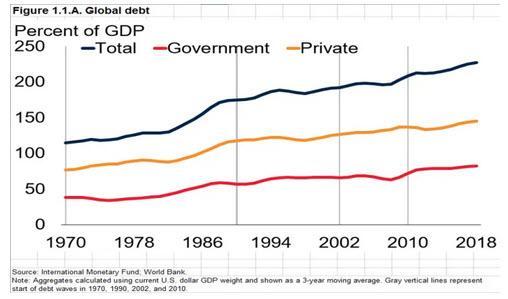
On the other hand, the BIS, the World Bank, and the IMF released year end reports filled to the gills about the concerns of unprecedented debt expansion:
“Our results show that public debt in its various forms is the most important predictor of fiscal crises and it does matter always and everywhere.”
IMF: Debt is Not Free 3 Jan20
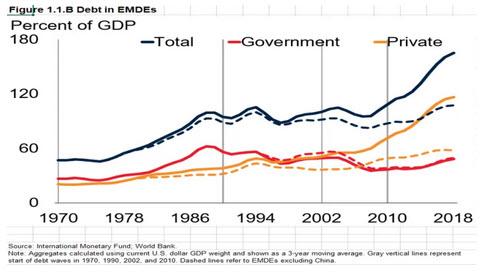
“The global economy has experienced four waves of debt accumulation over the past fifty years. The first three debt waves ended with financial crises in many emerging and developing economies. The latest, since 2010, has already witnessed the largest, fastest and most broad-based increase in debt in these economies. Their total debt has risen by 54 percentage points of GDP to a historic peak of almost 170 percent of GDP in 2018.”
The World Bank, Global Waves of Debt: Causes and Consequences Jan20
We are going to go out on a limb and suggest that it might be the unprecedented inflation (pun intended) of outstanding debt that the monetary policy nobility are missing in each and every of their senseless comments/arguments/conclusions. There is a reason they call end of cycle dislocations something like a “Debt Crisis” or “Credit Bubble” or “Default Cycle”, because debt is what matters! They don’t call it a “Slow Down in Productivity Crisis” or an “Asset Inflation Catastrophe” or a “Core PCE Deflator Bust”. You’ve heard us ask it over and over again – are central bankers idiots, or are they in on a wilful upward redistribution of wealth? Read through the above articles/speeches/papers from the elite of the elite in the central banking world and you will literally find not one mention of debt/credit/leverage. As always, the mention of it is so noticeable in its absence that it is hard to imagine it is anything other than intentional. They are the managers of a Ponzi scheme laying out every possible explanation other than what it actually is.
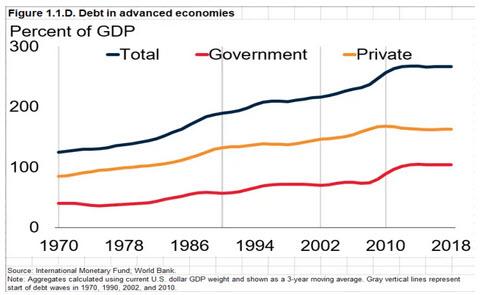
The IMF and World Bank pieces, on the other hand, focus on the actual state of the world. The World Bank piece comes with a link to a spreadsheet with the data behind their wonderful charts. What we take from these pieces, in particular the World Bank book, is that historically long periods of debt accumulation end in financial crisis, notably in Emerging and Developing Economies (EMDEs). The most recent wave of debt commenced in 2010 and now has the world at all-time unprecedented levels of debt, but what really stands out is the relative increase in debt in Emerging and Developing Economies, and specifically Private sector debt, overwhelmingly from China.
Figure 1: Global Debt
Figure 2: Debt in Advanced Economies
Figure 3: Debt in Emerging and Developing Economies
Other things that stand out – overall there has been no deleveraging post the 2007-2009 financial crisis; virtually all of the growth in accumulated debt in Advanced Economies has come from Government debt; the growth above trend of Private debt in EM, and particularly China, is prodigious. As we have discussed before, the end result of the extreme policy measure of the above noted Advanced Economy central bankers, aside from inflating asset prices in their own countries, was to drive debt accumulation into the developing world.
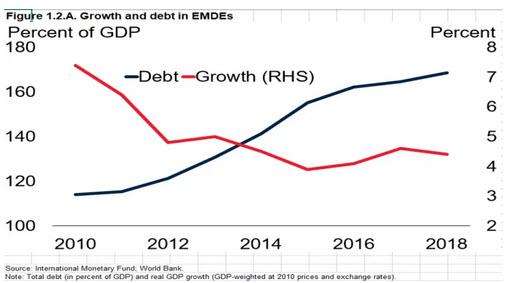
This leads to the problem very clearly depicted in the below graph. Despite the unprecedented expansion of debt, what some might proclaim a bringing forward of demand, growth in EMDEs continues to slow.
Figure 4: Debt to GDP vs GDP growth in Emerging and Developing Economies
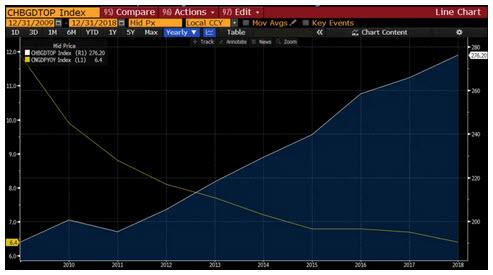
This picture, naturally, looks even more extreme if we strip it down to just China. Referencing our distinguished central banking friends, maybe it’s not “secular stagnation”, but rather an excess of accumulated debt? I go back to our old Snickers bar analogy. You have to be a pretty undiscerning doctor if you think your prescription of Snickers bars, to pick up lagging energy in your patient, has nothing to do with his weight gain and subsequent increased lack of energy. Sadly, there appears to be no accountability for the monetary physicians that have orchestrated the current lack of fitness for economies.
We couldn’t help ourselves and had to include the attached link to the recently created biggest Snickers bar ever – as far as we know no central bankers were involved in the making of it!
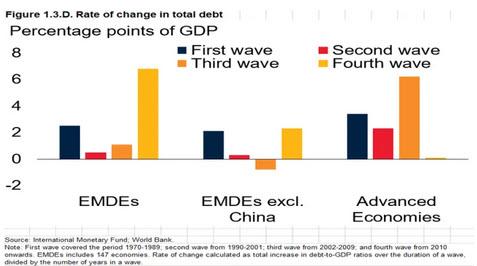
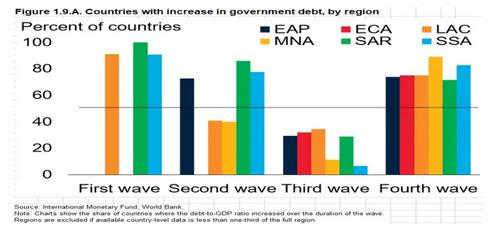
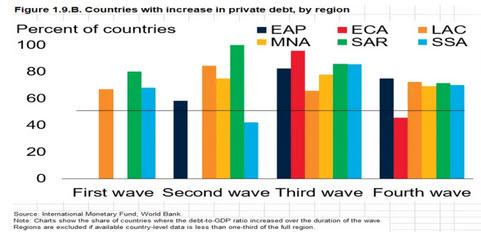
As ever, we have no particular insight as to what the future holds, how or when this cycle might end. Just simply that, thus far, they all end. The accumulation of debt doesn’t, per se, tell you where or when a fire might start, but rather where a spreading fire might cause the costliest damage. Again, the next three charts from the World Bank piece show that EMDEs, and in particular China, are where the combustible material has really built up in this wave.
Figure 6: Rate of Change of Total Debt (EMDEs – Emerging Market Developing Economies)
Figure 7: Pct. Countries with Increase in Govt Debt, EMDEs
Figure 8: Pct. Countries with Increase in Private Debt, EMDEs
All of our central banking gurus commented on the need for greater fiscal policy support in their respective economies, and we touched last month on the growing mainstreaming of things like MMT, Modern Monetary Theory (neither modern nor a theory), but is that sort of thing a solution that will prevent/delay another EMDEs financial crisis at the end of this debt wave? Can EMDEs that rely on foreigners to hold a significant portion of their domestic government debt, and on foreign currency as a significant portion of the private debt, smooth away cyclical end debt instability by ever greater levels of fiscal spending? The soft-landing unicorn has been historically scarce, and the extremes of this cycle make us sceptical that this time the guys behind the curtain will pull the levers just right.
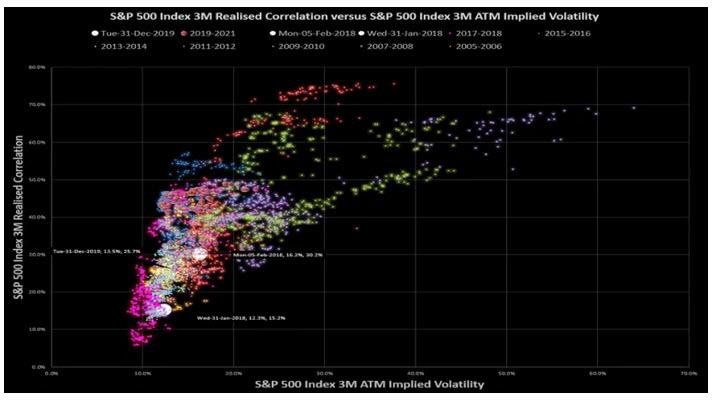
Figure 10: Volatility and Correlation Comet
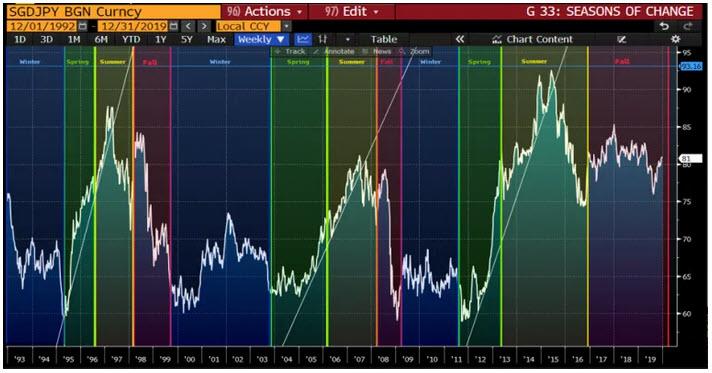
Figure 11: SGD/JPY ‘Seasons’
All of this leads us, yet again, to the same question: are you sufficiently confident in your defensive strategies that you are able to take sufficient risk to benefit from years like 2019? Are you catching the spectacular compounding opportunities in the up-tail, while confidently protecting the down-tail? Nobody should be satisfied with the high correlation and low returns of absolute return hedge fund strategies. Fixed income, which had a sensational 2019, still massively underperformed equities while offering increasingly little portfolio risk mitigation benefit. Should our central banking overlords continue to extend the cycle, there is no reason why asset prices can’t continue to drive ever higher. Should they fail………
During President Donald J. Trump’s impeachment trial, we’ll hear a lot of talk about our rules for governing. One frequent claim is that our nation is a democracy. If we’ve become a democracy, it would represent a deep betrayal of our founders, who saw democracy as another form of tyranny. In fact, the word democracy appears nowhere in our nation’s two most fundamental documents, the Declaration of Independence and the U.S. Constitution. The founders laid the ground rules for a republic as written in the Constitution’s Article IV, Section 4, which guarantees "to every State in this Union a Republican Form of Government."
John Adams captured the essence of the difference between a democracy and republic when he said,
"You have rights antecedent to all earthly governments; rights that cannot be repealed or restrained by human laws; rights derived from the Great Legislator of the Universe."
Contrast the framers’ vision of a republic with that of a democracy. In a democracy, the majority rules either directly or through its elected representatives. As in a monarchy, the law is whatever the government determines it to be. Laws do not represent reason. They represent power. The restraint is upon the individual instead of the government. Unlike that envisioned under a republican form of government, rights are seen as privileges and permissions that are granted by government and can be rescinded by government.
Here are a few quotations that demonstrate the contempt that our founders held for a democracy.
James Madison, in Federalist Paper No. 10, wrote that in a pure democracy, "there is nothing to check the inducement to sacrifice the weaker party or the obnoxious individual."
At the 1787 Constitutional Convention, Edmund Randolph said that "in tracing these evils to their origin every man had found it in the turbulence and follies of democracy." Alexander Hamilton agreed, saying: "We are now forming a republican government. (Liberty) is found not in "the extremes of democracy but in moderate governments. … If we incline too much to democracy, we shall soon shoot into a monarchy."
John Adams reminded us: "Remember, democracy never lasts long. It soon wastes, exhausts, and murders itself. There was never a democracy yet that did not commit suicide."
John Marshall, the highly respected fourth chief justice of the U.S. Supreme Court observed, "Between a balanced republic and a democracy, the difference is like that between order and chaos."
Thomas Paine said, "A Democracy is the vilest form of Government there is."
The framers gave us a Constitution replete with undemocratic mechanisms. One constitutional provision that has come in for recent criticism is the Electoral College. In their wisdom, the framers gave us the Electoral College as a means of deciding presidential elections. That means heavily populated states can’t run roughshod over small, less-populated states.
Were we to choose the president and vice president under a popular vote, the outcome of presidential races would always be decided by a few highly populated states, namely California, Texas, Florida, New York, Illinois and Pennsylvania, which contain 134.3 million people, or 41% of our population. Presidential candidates could safely ignore the interests of the citizens of Wyoming, Alaska, Vermont, North Dakota, South Dakota, Montana and Delaware. Why? They have only 5.58 million Americans, or 1.7% of the U.S. population. We would no longer be a government "of the people." Instead, our government would be put in power by and accountable to the leaders and citizens of a few highly populated states. It would be the kind of tyranny the framers feared.
It’s Congress that poses the greatest threat to our liberties. The framers’ distrust is seen in the negative language of our Bill of Rights such as: Congress "shall not abridge, infringe, deny, disparage, and shall not be violated, nor be denied." When we die and if at our next destination we see anything like a Bill of Rights, we know that we’re in hell because a Bill of Rights in heaven would suggest that God couldn’t be trusted.
California Is Building Lots To Contain "Thousands" Living In Their Cars Across The State
Today in "news you won’t hear from liberal American news organizations", it was reported this week that "thousands" of homeless California residents are being forced to live in their cars, amidst a growing housing crisis in the state.
California accounts for nearly half of the country’s homeless population. Ah, the sweet success of high taxes and liberal policies.
Even better is the solution that some California cities are implementing to try and deal with the issue. According to a report by France 24 news, several cities are now encouraging the practice, setting up parking lots where homeless people can "more securely" spend the night.
France 24 news interviewed several people in one lot, including a deliveryman who doesn’t make enough money to rent his own apartment. "Each car represents someone’s home," the report notes about this lot outside of San Diego.
One former homeless man, George Harris, actually turned the idea into a business, accruing 13 minivans which he has parked in various areas around Venice Beach, that he rents each for $300 per month. Each van comes with its own mattress, he told a reporter proudly.
The vans have to be moved every 3 days to avoid getting towed and Harris is actually fighting the city ordinance that requires this in order to try and get permission to keep people living in vans throughout the city. Residents throughout the city seem unamused by the practice.
"I called the police on one of his clients because the guy was defecating and urinating," one resident said about a van parked outside of her home.
"Totally false," Harris interrupted during the middle of her interview. "They make up stories about the van people."
On episode eight of “Verdict with Ted Cruz,” which was uploaded to YouTube on Thursday, the senator discusses four of the most critical questions asked during the “Question and Answer” portion of the ongoing Senate impeachment trial that took place on Wednesday.
The first question Cruz asked was, “as a matter of law, does it matter if there was a quid pro quo?”
Cruz noted that the Democrats are “bickering back and forth” about a quid pro quo because it would tie into bringing in former National Security Advisor John Bolton as a new witness.
“And my point is … it doesn’t matter. It makes no impact on the legal issue,” Cruz said. “And so that was the question I wanted to emphasize at the outset to make clear the legal question is, does the president have the authority to do what he did? And in this instance – look, a point I’ve been making from the beginning, a president always has the authority to investigate corruption if there’s credible evidence.”
Knowles asked Cruz if he was “satisfied” with the answer given, and Cruz said that he was. He then explained that even the new Middle East peace proposal is a quid pro quo.
The president is promising, among other things, to the Palestinians, that collectively, the United States and other countries will invest $50 billion if the Palestinians stop terrorism. That’s a quid pro quo. That’s an exchange that happens in foreign policy all the time.
Cruz added that this is an important point to make clear because what “an awful lot of what people are fighting about doesn’t affect the question, the legal question before the Senate, of whether the president committed impeachable crimes, whether the president committed high crimes and misdemeanors.”
Cruz continued, stating that his second question arose out of a hypothetical from Rep. Adam Schiff (D-CA) pertaining to Obama investigating Mitt Romney in 2012.
“Lindsey Graham came up to me … what if Obama had evidence that Romney was corrupt?” Cruz said. “And I’m like, that’s good.”
Cruz then offered the question, which he penned and Sen. Lindsey Graham (R-SC) asked:
If President Obama had evidence that Mitt Romney’s son was being paid a million dollars a year by a corrupt Russian company … and Romney had acted in his official capacity to benefit that company, would Obama have had the authority to ask that the potential corruption be investigated?
As for the answer, Cruz said that while Republicans knew the Democrats would try to “filibuster the question … there’s value … to teeing up that hypothetical, making clear that their position is, doesn’t matter what evidence of corruption you have, you can’t have an investigation if it’s your political rival. Well, that’s just nutty. I mean, that’s not the law. That doesn’t make any sense.”
Cruz said that Schiff’s alleged refusal to answer the question provided insight, especially in light of his responses to the following questions.
Cruz’s third question pertained to the whistleblower:
So, this is a question I had written out before that points out that the inspector general for the intelligence community wrote that the whistleblower had some indicia of arguable political bias in favor of a rival political candidate … I said, look, did the whistleblower ever work for Joe Biden? If so, did he work for Joe Biden on issues involving Ukraine? If so, did he assist in any material way with the quid pro quo that Joe Biden executed when he demanded that Ukraine fire the prosecutor that was investigating Burisma, the company paying his son a million bucks a year?
According to Cruz, Schiff “utterly dodge[d]” and wouldn’t “answer.” Instead, he offered a “prepared speech” about protecting the identity of whistleblowers, which had nothing to do with the question.
Cruz told Knowles that Schiff’s answer frustrated him, so he went back to the “cloak room” to write another question, which was then asked by Sen. David Perdue (R-GA):
You refused to answer the question on political bias. Are the House managers refusing to tell the Senate whether or not the so-called whistleblower had an actual conflict of interest? And the question went on to say … there are seven billion people on planet Earth. Almost all had no involvement, zero involvement, in Biden’s quid pro quo. Are the House managers unwilling to say whether the so-called whistleblower was a fact witness who directly participated in, and could himself face criminal or civil liability, for Joe Biden’s demanding Ukraine fire the prosecutor who was investigating Burisma?
Once again, according to Cruz, Schiff refused to answer the question:
So Adam Schiff, the position of the House managers, they refuse to tell you whether this so-called whistleblower has actual bias, has a conflict of interest, and if he actively participated, if he was working for Joe Biden, and if he was the guy Joe Biden used to say, “Hey, go to the Ukrainians and cut off their military aid until they fire this prosecutor.”
“For all we know, and there are reasons to suspect, based on what the inspector general said, that this so-called whistleblower is not some disinterested third party. He’s right in the middle,” Cruz said. “If an investigation shows Biden is, in fact, corrupt, it is entirely possible, or at least the House managers wouldn’t tell us, if this so-called whistleblower was worried about his own rear end, was worried about, wait a second, if they go after Biden, they’re going to prosecute me because I was involved in this corruption.”
Cruz told Knowles that House managers wouldn’t answer that, but also that Schiff, who “just kind of riff[s],” actually read “word for word” from a piece of paper:
Look, he’s under oath … and it was really clear that he didn’t want to say something on this, about what the inspector general said were significant indications of political bias on the part of the whistleblower. And that suggests this whole thing was cooked up in the beginning, and was a crock from day one.
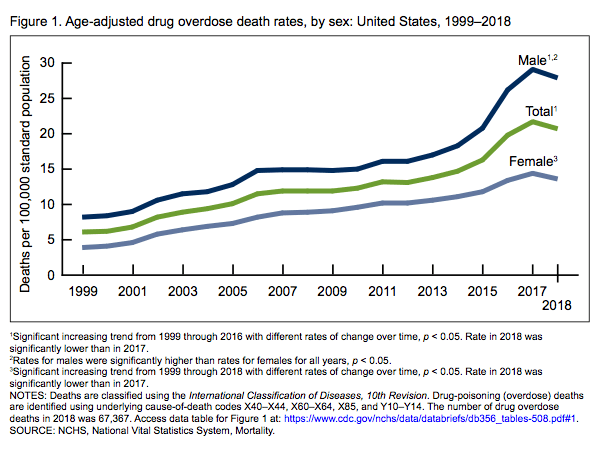
The number of drug deaths dropped sharply in 2018 after 28 years of rising casualties, and Americans’ life expectancy also reversed its decline, rising by one month to 78.7 years, according to the U.S. Centers for Disease Control and Prevention.
The drop in drug deaths saved roughly 2,900 lives, and it follows a massive death spike under President Barack Obama, whose progressive deputies did little to discover or curb the massive spike in deaths from opioids and fentanyl shipped from Mexico and China. “The age-adjusted rate of drug overdose deaths increased … by 2% per year from 2006 through 2013, and by 14% per year from 2013 through 2016,” the CDC reported.
In May 2016, a group of national health experts issued an urgent plea in a private letter to high-level officials in the Obama administration. Thousands of people were dying from overdoses of fentanyl — the deadliest drug to ever hit U.S. streets — and the administration needed to take immediate action. The epidemic had been escalating for three years.
“The fentanyl crisis represents an extraordinary public health challenge — and requires an extraordinary public health response,” the experts wrote to six administration officials, including the nation’s “drug czar” and the chief of the Centers for Disease Control and Prevention.
The administration considered the request but did not act on it.
Under President Donald Trump, the death toll has dropped by 4.5 percent — or roughly 2,900 lives per year — amid a growing economy that is pulling sidelined Americans back into jobs. That gain is aided by Trump’s rejection of business demands for more migrants, and his increased actions against drug smuggling from Mexico and China. The partial recovery is showcased by a January 30 report in the New York Times:
“It’s literally like coming out of a fog,” said Andrew Wright, 34, who has been drug-free since August 2018, when he entered treatment at the Counseling Center in Portsmouth, Ohio. Medicaid, the government insurance program, covered his care. “It’s like I’m 22 and I’ve finally made it out of my parents’ house, embracing life for the first time. I’m learning how to live.”
…
… he has now stayed off drugs for the longest period in his adult life, he said, a fact he attributes to his treatment program together with a change in the attitudes of the people in his town. A small grooming products company, Doc Spartan, hired him to make beard oil and grenade-shaped soap. Someone sold him a cheap car. Others helped him start sorting out his life — getting driver’s license, dealing with his unpaid bills and getting treatment for hepatitis C.
“I literally feel like I’m a soldier in this war, and I really like it,” said Mr. Wright, who now works as a trainer at PSKC, a CrossFit gym, and at a halfway house.
The U.S. Centers for Disease Control and Prevention reported January 29:
In 2018, the age-adjusted rate of drug overdose deaths in the United States was 4.6% lower than the rate in 2017.
In 2018, there were 67,367 drug overdose deaths in the United States (Figure 1), 4.1% fewer deaths than in 2017 (70,237).
The death toll fell in several midwest states which had been hit hard by outsourcing and free trade:
The drug overdose death rate was lower in 2018 than in 2017 for 15 jurisdictions: Alaska, the District of Columbia, Florida, Georgia, Indiana, Iowa, Kentucky, Maine, Minnesota, New York, North Carolina, Ohio, Pennsylvania, West Virginia, and Wisconsin (Figure 2).
The drug overdose death rate was higher in 2018 than in 2017 for 5 states: California, Delaware, Missouri, New Jersey, and South Carolina.
But the good news is mixed with bad news:
In 2018, the states with the highest age-adjusted drug overdose death rates were West Virginia (51.5 per 100,000 standard population), Delaware (43.8), Maryland (37.2), Pennsylvania (36.1), Ohio (35.9), and New Hampshire (35.8).
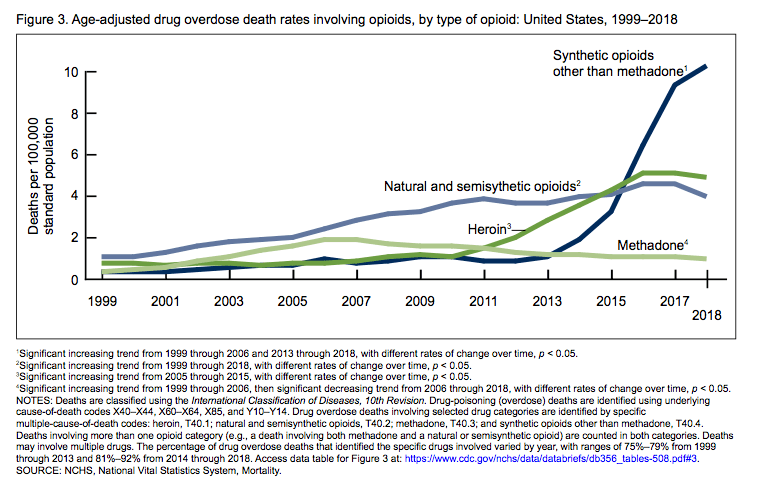
The death rate from “synthetic opioids” — such as fentanyl — grew slower than in prior years, while the deaths from heroin and opioids fell:
Better cancer treatments also saved many lives and to extend lifespans to 78.7 years, according to the CDC. The New York Times reported:
Improvements in cancer mortality rates represented the single largest share of the life expectancy gain in 2018, about 30 percent. Next came the decline in so-called unintentional injuries, which include deaths from car accidents and drug overdoses. That category accounted for about 25 percent of the gain, a change that was driven almost entirely by a decline in drug deaths …
But life expenctancy remains below the 2014 peak, according to a January 30 report in the Washington Post:
A decline in the death rate from cancer is the single largest driverof the small increase in life expectancy,the CDC reported. Five of the other nine leading causes of death also showed declines in death rates, including the top cause, heart disease, as well as unintentional injuries (which include overdoses), chronic lower respiratory diseases, stroke and Alzheimer’s disease. Two more, diabetes and kidney disease, were essentially unchanged. Deaths from suicide and influenza and pneumonia increased.
Despite the encouraging elements of the CDC mortality report, the broader pattern for American health remains sobering. Life expectancy improved by the tiniest of increments, from 78.6 to 78.7 years. That figure remains lower than the peak in U.S.life expectancy, at 78.9 years,in 2014.
…
“It’s good news that there was an increase in life expectancy. That’s what we want to see, but it doesn’t really alter the long-term picture. We still have a very bleak situation at this point,” said Steven H. Woolf, director emeritus of the Center on Society and Health at Virginia Commonwealth University.
In October 2019, federal data also showed that Trump’s policies have also reduced the murder rate in the United States.
Nationwide, homicides spiked to 15,195 in 2016, up from 12,278 murders in 2014 when Obama and his progressive and media allies began blaming police forces for multiple episodes in which young black men were killed.
Since then, Trump has ended the White House support for the Black Lives Matter movement, and the number of murders was forced down to 14,123 in 2018, according to new FBI data. The murder rate dropped by 6.8 percent from 2017 to 2018, saving more than 1,000 lives.
Thanks to our pro-worker, pro-American economic policies, unemployment is at the lowest level in more than 50 years. We have created over 7 MILLION new JOBS. More Americans are working today than EVER before. We have the hottest ECONOMY on earth! pic.twitter.com/TRGKRF7xgQ
President Trump announced a historic peace plan for Israel and Palestine.
The peace plan has two parts; it creates an independent Palestinian state while permanently acknowledging that Jerusalem is Israel’s capital.
Israel Prime Minister Benjamin Netanyahu praised President Trump’s peace plan emphasizing that it was both practical and realistic because it balances Israel’s national security with Palestine’s aspirations for statehood.
Netanyahu concluded, “You have been the greatest friend that Israel has ever had in the White House.”
When is a socialist not a socialist? When he or she is a Democrat.
Many people are perplexed that in the middle of one of the greatest economic periods in our nation’s history, the longest economic expansion on record, at a time when more people are doing well than ever before, so many people appear have such an attraction to what they call socialism. Many were shocked when a Gallup poll earlier this year found that 43 percent of Americans believe socialism would be a good thing for America and a later Pew Poll found 42 percent of Americans expressed a positive view of socialism.
The Gallup poll was an attitude survey exploring how American’s attitudes toward socialism have changed over the years. The Gallup survey indicated that American’s definition of Socialism has changed. Today, nearly a quarter of Americans associate socialism with social equality and only 17 percent associate it with the classical economic definition of controlling the means of production. Ever since 2010, a majority of Democrats polled by Gallup have viewed socialism positively.
In an interesting variation to the question on preference for socialism, Gallup asked its respondents whether they would prefer government control or a free market in a number of market and societal activities. The answers were mixed.
The respondents strongly favored a free market in technological innovation (76 percent), distribution of wealth (68 percent), the economy overall (62 percent) and wages (62 percent). They favored government control of environmental protection (66 percent) and protecting consumer privacy online (57 percent).
In healthcare, the respondents favored free market control by 53 percent and in higher education they favored free-market control by 56 percent. This is interesting since these are two of the major socialist legs of the current Democratic platform and they seem to have tepid support.
The significant takeaway from the Gallup Poll is that Americans tend not to view the word “socialism” in classic terms but the view is very mixed. They say they favor equality and fairness but then strongly favor free-market control of innovation, wealth distribution and wages. Definitely not Marx or Engels.
While 47 percent of those surveyed say they would vote for a socialist candidate for President, 58 percent said they would vote for an atheist and 60 percent for a Muslim. So does socialist mean anything?
Today’s definition and concept of socialism is apparently muddy and ill defined. What remains consistent and strong is the American disposition toward the free market, even in those who call themselves socialists.
While the Gallup Poll looked at changing attitudes, the Pew Poll was more of a snapshot of what people are thinking today and a contrast of America’s views of capitalism versus socialism.
Here, the contrasting views were interesting in that those who had a positive view of socialism and a negative view of capitalism tended to hold the very shallow “talking point” issues so common among the generally uninformed. Those who held a positive view of capitalism and negative view of socialism demonstrated a slightly higher understanding of the systems. Neither set of views really captured the essential qualities of either system and indicated a general systemic emotional response.
Respondents viewing capitalism negatively cited “benefits only a few/unequal distribution of wealth” (23 percent) and “exploitive in nature” (20 percent). On the positive side of socialism they cited “creates a fairer, more generous system (31 percent) and “builds upon and improves capitalism” (20 percent). No explanation for how this might work was offered.
On the positive view of capitalism, respondents noted “promotes individual opportunity” (24 percent), “general positivity” (22 percent) and “essential to America” (20 percent). On the negative side of socialism, respondents cited, “undermines the work ethic” (19 percent), “historic and comparative failure” (18 percent) and “undermines democracy” (17 percent).
Collectively, what do these two surveys indicate? Gallup said that in technology, the economy and wages, roughly 75% of Americans favored the free market. The Pew Poll said that 65 percent of Americans had a positive view of capitalism.
Of those surveyed by Gallup, about 60 percent favored government control of the environment and online privacy. The Pew Poll indicated that those positively disposed toward socialism were so inclined because it promotes a fairer, more generous system and that it builds upon and improves capitalism.
None of those surveyed commented on socialism as a form of government or seemed aware that under a socialist system they lose individual rights. Those who viewed socialism positively seemed to do so mostly because they saw it as “fairer”, presumably because at present others had more than they did. None commented on the tax implications of socialism and, in fact, were negatively disposed to this facet of socialism because they were strongly supportive of the free market with regard to the market and the distribution of wealth. This is an internally contradictory view.
If roughly two thirds of Americans are not favorably inclined to socialism and favor the free market with regard to economic issues, and over half favor free market control of healthcare and higher education, to whom do the current slate of Democratic candidates think they appeal? The campaign platforms of all the remaining candidates are decidedly socialist; universal healthcare, free college, elimination of college debt, Green New Deal. While the surveys indicate that roughly two thirds of those surveyed were in favor of government control of environmental issues, that quickly becomes an economic issue where free market again becomes the favored mechanism.
As the Democratic field falls all over itself to move ever further left toward a more classic socialism, it appears that there is ample data to substantiate what most know intuitively; they are moving further away from their voters, who have no idea what that is. This is when a socialist is not a socialist -– when they are Democrats.
The only common thread in all of Democratville is their hatred of Donald J. Trump – Trump Derangement Syndrome. That is clearly manifest in the sham impeachment frenzy but that will fall far short of sufficient substance to win the election. It is disintegrating as we watch.
With no discernable path to victory for the Democrats and a bacchanalian rite in progress guaranteed to shred their party, one can only see a resounding victory for the President this fall.
When is a socialist not a socialist? When he or she is a Democrat.
Many people are perplexed that in the middle of one of the greatest economic periods in our nation’s history, the longest economic expansion on record, at a time when more people are doing well than ever before, so many people appear have such an attraction to what they call socialism. Many were shocked when a Gallup poll earlier this year found that 43 percent of Americans believe socialism would be a good thing for America and a later Pew Poll found 42 percent of Americans expressed a positive view of socialism.
The Gallup poll was an attitude survey exploring how American’s attitudes toward socialism have changed over the years. The Gallup survey indicated that American’s definition of Socialism has changed. Today, nearly a quarter of Americans associate socialism with social equality and only 17 percent associate it with the classical economic definition of controlling the means of production. Ever since 2010, a majority of Democrats polled by Gallup have viewed socialism positively.
In an interesting variation to the question on preference for socialism, Gallup asked its respondents whether they would prefer government control or a free market in a number of market and societal activities. The answers were mixed.
The respondents strongly favored a free market in technological innovation (76 percent), distribution of wealth (68 percent), the economy overall (62 percent) and wages (62 percent). They favored government control of environmental protection (66 percent) and protecting consumer privacy online (57 percent).
In healthcare, the respondents favored free market control by 53 percent and in higher education they favored free-market control by 56 percent. This is interesting since these are two of the major socialist legs of the current Democratic platform and they seem to have tepid support.
The significant takeaway from the Gallup Poll is that Americans tend not to view the word “socialism” in classic terms but the view is very mixed. They say they favor equality and fairness but then strongly favor free-market control of innovation, wealth distribution and wages. Definitely not Marx or Engels.
While 47 percent of those surveyed say they would vote for a socialist candidate for President, 58 percent said they would vote for an atheist and 60 percent for a Muslim. So does socialist mean anything?
Today’s definition and concept of socialism is apparently muddy and ill defined. What remains consistent and strong is the American disposition toward the free market, even in those who call themselves socialists.
While the Gallup Poll looked at changing attitudes, the Pew Poll was more of a snapshot of what people are thinking today and a contrast of America’s views of capitalism versus socialism.
Here, the contrasting views were interesting in that those who had a positive view of socialism and a negative view of capitalism tended to hold the very shallow “talking point” issues so common among the generally uninformed. Those who held a positive view of capitalism and negative view of socialism demonstrated a slightly higher understanding of the systems. Neither set of views really captured the essential qualities of either system and indicated a general systemic emotional response.
Respondents viewing capitalism negatively cited “benefits only a few/unequal distribution of wealth” (23 percent) and “exploitive in nature” (20 percent). On the positive side of socialism they cited “creates a fairer, more generous system (31 percent) and “builds upon and improves capitalism” (20 percent). No explanation for how this might work was offered.
On the positive view of capitalism, respondents noted “promotes individual opportunity” (24 percent), “general positivity” (22 percent) and “essential to America” (20 percent). On the negative side of socialism, respondents cited, “undermines the work ethic” (19 percent), “historic and comparative failure” (18 percent) and “undermines democracy” (17 percent).
Collectively, what do these two surveys indicate? Gallup said that in technology, the economy and wages, roughly 75% of Americans favored the free market. The Pew Poll said that 65 percent of Americans had a positive view of capitalism.
Of those surveyed by Gallup, about 60 percent favored government control of the environment and online privacy. The Pew Poll indicated that those positively disposed toward socialism were so inclined because it promotes a fairer, more generous system and that it builds upon and improves capitalism.
None of those surveyed commented on socialism as a form of government or seemed aware that under a socialist system they lose individual rights. Those who viewed socialism positively seemed to do so mostly because they saw it as “fairer”, presumably because at present others had more than they did. None commented on the tax implications of socialism and, in fact, were negatively disposed to this facet of socialism because they were strongly supportive of the free market with regard to the market and the distribution of wealth. This is an internally contradictory view.
If roughly two thirds of Americans are not favorably inclined to socialism and favor the free market with regard to economic issues, and over half favor free market control of healthcare and higher education, to whom do the current slate of Democratic candidates think they appeal? The campaign platforms of all the remaining candidates are decidedly socialist; universal healthcare, free college, elimination of college debt, Green New Deal. While the surveys indicate that roughly two thirds of those surveyed were in favor of government control of environmental issues, that quickly becomes an economic issue where free market again becomes the favored mechanism.
As the Democratic field falls all over itself to move ever further left toward a more classic socialism, it appears that there is ample data to substantiate what most know intuitively; they are moving further away from their voters, who have no idea what that is. This is when a socialist is not a socialist -– when they are Democrats.
The only common thread in all of Democratville is their hatred of Donald J. Trump – Trump Derangement Syndrome. That is clearly manifest in the sham impeachment frenzy but that will fall far short of sufficient substance to win the election. It is disintegrating as we watch.
With no discernable path to victory for the Democrats and a bacchanalian rite in progress guaranteed to shred their party, one can only see a resounding victory for the President this fall.





 Here, the contrasting views were interesting in that those who had a positive view of socialism and a negative view of capitalism tended to hold the very shallow “talking point” issues so common among the generally uninformed. Those who held a positive view of capitalism and negative view of socialism demonstrated a slightly higher understanding of the systems. Neither set of views really captured the essential qualities of either system and indicated a general systemic emotional response.